
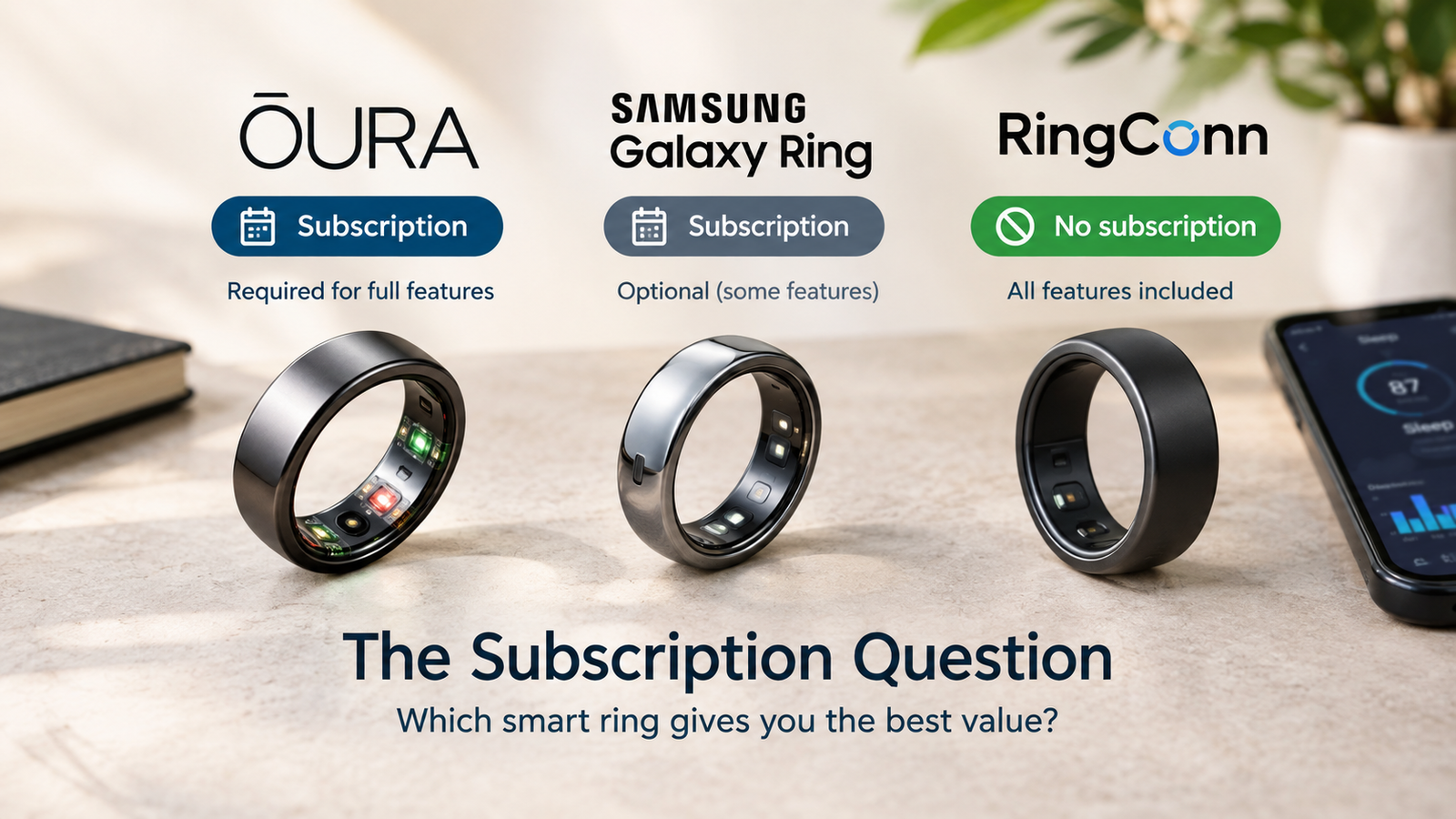
RingConn wins for most buyers because it avoids recurring monthly fees while tracking essential metrics. Oura remains the right choice only if you want access to over 50 health metrics backed by ongoing updates through its membership plan.
What each one is for
RingConn is a smart ring that tracks sleep, activity and health metrics, sold as a one-time hardware purchase rather than a subscription service.
Oura uses the Oura Membership current plan name to deliver its full feature set to individual users.
Our read: When you look at what these devices are designed to accomplish, the financial commitment is the primary dividing line. You are choosing between an upfront hardware purchase that unlocks everything permanently and a hardware purchase that requires an ongoing fee to keep working at its full potential. Think carefully about how you feel about recurring bills for physical goods you already own. Most people underestimate the annoyance of a monthly charge attached to a piece of jewelry on their finger. If you prefer to pay once and forget about future invoices, the hardware approach aligns better with traditional watch ownership. If you do not mind a membership model to support software evolution, the alternative structure makes sense. Read the fine print on billing terms before you pick your device.
- RingConn relies entirely on a single upfront payment for full access.
- Oura ties its continuous feature updates to an ongoing service model.
- Team and enterprise buyers should look elsewhere because these devices focus on individual tracking.
How they compare on capability
Oura tracks over 50 health metrics and gets personalized insights into your sleep, activity, stress, and more under the Oura Membership.
RingConn tracks sleep, activity and health metrics as part of its one-time hardware purchase.
The capability gap centers on breadth versus simplicity in your daily health monitoring. Oura provides a massive web of data points that dig deep into your physiological state, which appeals to data nerds who want every possible metric logged. RingConn covers the fundamentals of daily activity and nightly rest without overwhelming you with complex sub-scores. Ask yourself if you actually look at fifty different metrics every morning or if you just want to know how well you slept and how many steps you took. Buying extra capability you never check wastes your money and clutters your mobile app interface. Pick the depth of data that matches your actual daily habits rather than your theoretical tracking ambitions.
- Oura provides specific tracking for stress and over 50 distinct health metrics.
- RingConn focuses on core tracking for sleep and daily movement.
- All features are unlocked with the one-time hardware purchase for RingConn.
How they compare on price
Oura Membership costs $5.99 USD /month or $69.99 USD /year.
RingConn has no subscription plans exist and there is only the one-time ring purchase price.
RingConn exact current price varies with live promotions on RingConn’s own store.
Math matters when you calculate the total cost of ownership over a three-year span. Oura demands the initial ring purchase plus either $5.99 USD per month or $69.99 USD per year, which adds up significantly over time. RingConn asks for the hardware price once and never sends another bill for software access. Over three years, the membership fees on Oura create a stark financial difference between the two choices. Calculate what you will spend by month thirty-six before you click buy. If you keep your fitness trackers for multiple years, avoiding the subscription model saves enough cash to buy another device entirely.
- Oura requires recurring payments unless you choose the annual billing rate.
- RingConn features a one-time hardware price only with no recurring fee.
- Free tier limits are not applicable for RingConn because there is no subscription tier structure to compare against.
Where the first option wins
Oura wins when you want personalized insights into your sleep, activity, stress, and more.
Oura wins by tracking over 50 health metrics for users who want deep data analysis.
Choose Oura if your primary goal is maximum data granularity and you accept the ongoing cost as part of your health budget. The depth of the insights makes it a powerful tool for spotting subtle trends in your recovery and daily stress levels. Do not buy this option if you plan to cancel the membership later, because losing access to your historical data dashboard diminishes the value of the hardware. Commit to the recurring fee or look elsewhere. Make sure you check the annual billing option if you decide to go this route, as it shaves a bit off the monthly accumulation.
- Oura provides detailed stress tracking alongside sleep and activity.
- Oura delivers granular insights through its membership platform.
- Oura suits individual users who want comprehensive health monitoring.
Where the second option wins
RingConn wins by offering all features unlocked with the one-time hardware purchase.
RingConn wins by eliminating recurring subscription fees entirely.
RingConn wins decisively for anyone who resents paying rent on physical technology they already bought. The absence of a subscription tier structure means you never have to worry about your app locking up features because a credit card expired. It is a straightforward, honest transaction that respects your wallet over the long haul. Keep an eye on live promotions on the vendor store to secure the best hardware price before ordering your sizing kit. This approach gives you peace of mind and keeps your monthly expenses clean of accessory charges.
- RingConn avoids any ongoing service charges.
- RingConn tracks sleep, activity and health metrics without paywalls.
- RingConn ensures you own your software access permanently upon purchase.
Which to choose, by use case
Choose RingConn if you want to track sleep, activity and health metrics without a subscription service.
Choose Oura if you want to track over 50 health metrics and pay $5.99 USD /month or $69.99 USD /year.
Match your buying decision to your personal financial philosophy rather than marketing claims. If you hate monthly subscriptions on principle, buy RingConn and check the store for current promotions. If you want the deepest possible health metrics and budget for the Oura Membership fee of $69.99 USD per year, go with Oura. Do not compromise on the subscription point, because that friction point causes the most buyer remorse down the road. Decide how much you value your data depth versus your ongoing wallet share, then execute your purchase.
- Select RingConn for a one-time hardware purchase with all features unlocked.
- Select Oura for personalized insights across sleep, activity, and stress.
- Avoid both if you need enterprise-level management tools for large teams.
Verdict
RingConn is the better smart ring for most buyers due to its one-time hardware pricing model.
Oura is reserved for users who specifically demand over 50 health metrics and continuous membership insights.
Buy RingConn unless you specifically need the extra metric depth and personalized insights locked behind the Oura Membership paywall. The subscription model of Oura adds up over the years, making RingConn the smarter financial choice for long-term ownership. Order your sizing kit first to guarantee a proper fit before finalizing your ring purchase.
- RingConn delivers all features unlocked for a single hardware price.
- Oura requires accepting the Oura Membership cost of $5.99 USD /month or $69.99 USD /year.
- Individual users should pick based on their tolerance for recurring software fees.
Prices are as published by the vendor in US dollars. What you pay locally may differ once tax and currency conversion are applied.
How we verified this
Evidence level: Editorial comparison of verified public information. TNTReview did not test this product directly. Every factual claim above comes from the official sources listed here.
- Ouraring official site, checked 2026-09-12 (1 fact on this page)
- Ouraring pricing page, checked 2026-09-12 (2 facts on this page)
- Ringconn pricing page, checked 2026-09-28 (4 facts on this page)
What we could not confirm: the official pages we checked did not state the exact free usage allowance. Rather than estimate, we left it out of this article.
Last verified: 2026-09-28