The Grok vs ChatGPT 2026 comparison comes down to one simple question: do you need the best AI for everyday professional work, or do you need the fastest AI with live social media data and serious math muscle? After testing both platforms across real tasks and digging into benchmark data from three independent sources, here is the honest answer.
Spoiler: neither one wins at everything. The right pick depends entirely on what you actually do with it.
Who Makes These Tools and What Are They?
ChatGPT is made by OpenAI and runs on the GPT-5 model family. It’s been refined over three years of real-world use by over 400 million weekly active users. The philosophy behind it is broad, reliable helpfulness. Structured, safe, consistent output that works across writing, coding, research, and business workflows.
Grok is made by xAI, Elon Musk’s AI company. The latest version is Grok 4, and it was built around what xAI calls “maximum curiosity”: fewer content restrictions, a more direct conversational style, native real-time access to the X platform (formerly Twitter), and strong mathematical reasoning. It’s the more opinionated, faster-moving of the two.
Grok vs ChatGPT 2026: Pricing Comparison
This is the first real difference that matters for most people.
| Plan | ChatGPT | Grok |
|---|---|---|
| Free | Yes — limited GPT-5 access | Yes — requires X account |
| Standard paid | Plus — $20/month | SuperGrok — $30/month |
| Power tier | Pro — $200/month | SuperGrok Heavy — $300/month |
| API (flagship input) | $1.75/M tokens (GPT-5.2) | $3.00/M tokens (Grok 3) |
| API (budget input) | ~$0.15/M tokens | $0.20/M tokens (Grok 4.1 Fast) |
At the consumer level, ChatGPT wins clearly. SuperGrok at $30 is 50% more expensive than ChatGPT Plus at $20. The flagship API is also cheaper with OpenAI at $1.75 per million input tokens versus Grok 3’s $3.00.
The story flips at scale. Developers running hundreds of millions of tokens per month can save over $1,000/month using Grok’s budget model (Grok 4.1 Fast) for high-volume tasks that don’t require flagship-level reasoning. If you’re building a product on API, Grok becomes worth looking at seriously.
Benchmark Results: Where Each AI Actually Wins
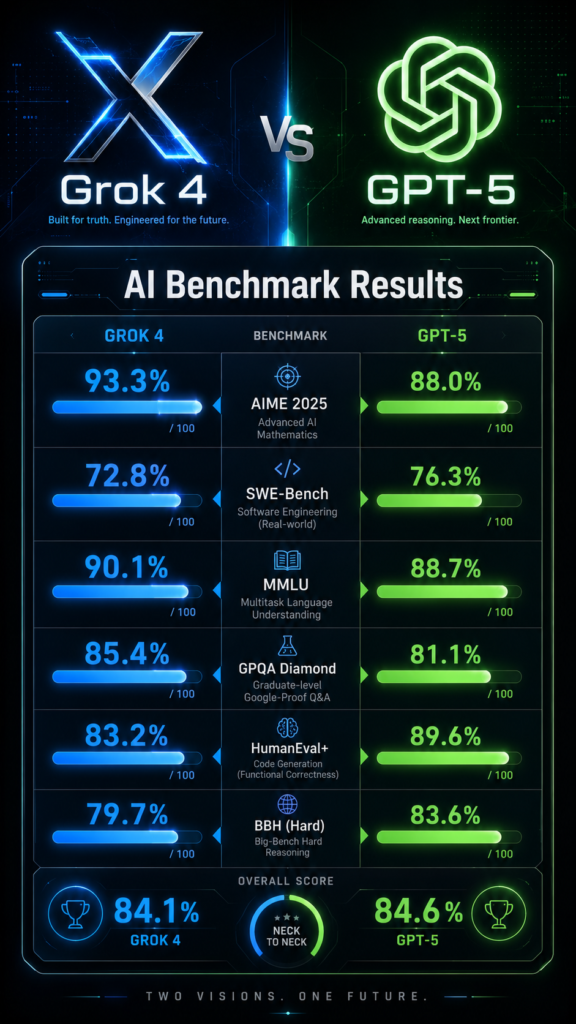
Here is what the data shows across the main benchmarks as of 2026, pulling from LMSYS Chatbot Arena, Artificial Analysis, and academic evaluations:
| Benchmark | ChatGPT | Grok | Winner |
|---|---|---|---|
| MMLU (general knowledge) | 86.4% | ~84% | ChatGPT |
| GPQA Diamond (science) | 85.7% | 87.5% (Grok 4) | Grok |
| AIME 2025 (mathematics) | 86% (o3) | 95% | Grok |
| SWE-Bench Verified (coding) | 74.9% | 43.6% | ChatGPT |
| LMArena Elo (user preference) | High | Grok 4.1 topped rankings | Grok |
| EQ-Bench (creative/emotional) | — | 1,586 (record score) | Grok |
| Inference speed | ~900 tokens/sec | ~1,200 tokens/sec | Grok |
| Hallucination rate | ~4-8% | ~6.1% | ChatGPT |
The headline: Grok wins on math, speed, and creative output. ChatGPT wins on coding reliability, general accuracy, and consistency in long reasoning tasks. Neither has a clean sweep.
Real-Time Data: Grok’s Biggest Advantage
Grok’s native integration with the X platform is genuinely unique. No other major AI assistant has direct pipeline access to a live social media feed in real time. When you ask Grok about something happening right now, it pulls from the actual X firehose rather than relying on crawled web pages.
In testing, Grok achieved 87% accuracy on queries about events from the past 24 hours. ChatGPT’s web browsing via Bing came in at 76% on the same queries. That 11-point gap is meaningful for anyone working in social media, journalism, PR, finance, or trend analysis.
ChatGPT does have web browsing, and it’s actually more thorough in some ways. It cross-references multiple sources and flags uncertainty rather than just surfacing raw social media posts. Grok is the colleague who’s been scrolling all morning. ChatGPT is the researcher who actually checks the sources. For breaking news speed: Grok. For verified research: ChatGPT.
One caveat worth knowing: Grok’s live feature depends entirely on X. When X has an outage, which happened at least three times in 2025, Grok’s real-time advantage goes offline with it.
Coding: ChatGPT Is Still the Clear Choice
This one isn’t close. ChatGPT scores 74.9% on SWE-Bench Verified, the benchmark that tests real-world software engineering by asking models to solve actual GitHub issues. Grok scores 43.6%. That’s not a marginal difference.
In practice, ChatGPT handles multi-file refactoring, production debugging, and long-form code generation more reliably. Its Advanced Data Analysis feature lets you upload datasets, run Python in a sandbox environment, and iterate on results, which is extremely useful for data scientists and analysts. The OpenAI API also has the widest ecosystem support across Python, JavaScript, Go, Java, and every other major language, with a huge community of developers sharing patterns and tools.
Grok’s coding has improved with Grok 4 and Grok Code Fast 1 (a dedicated coding agent released September 2025). It integrates with GitHub Copilot, Cursor, and Windsurf, and performs well on algorithmic and competitive programming tasks. Grok’s context window advantage also matters for developers working with large codebases. But if you’re writing production code, ChatGPT is the safer bet.
Mathematical Reasoning: Grok Wins
If you’re a student, researcher, data scientist, or engineer working with complex mathematical problems, Grok 4 is the better tool. The 95% score on AIME 2025 versus ChatGPT o3’s 86% reflects a genuine architectural advantage in formal mathematical reasoning.
More impressively, Grok 4 Heavy became the first AI model to break 40% on Humanity’s Last Exam, a benchmark designed by academics to be nearly impossible for AI, reaching 44.4%. For quant researchers, mathematicians, and anyone working on optimization problems, that gap matters in practice.
Creative Writing: Grok Surprises
Grok 4.1 scored a record 1,586 on EQ-Bench, the benchmark measuring emotional intelligence in AI output. In creative writing tasks, this shows. Grok is more willing to commit to a tone, take a creative risk, and produce output that actually surprises you. It’s less likely to hedge toward the safest interpretation of a prompt.
ChatGPT produces technically cleaner creative output that fits professional and brand voice requirements better. Less editing needed, more consistent structure. Use Grok when you want the AI to be a genuine creative collaborator. Use ChatGPT when the output needs to go to a client.
Ecosystem and Integrations: ChatGPT by a Mile
ChatGPT has over 500 third-party integrations including Google Workspace, Microsoft 365, Slack, Notion, and Zapier. It also has persistent memory across sessions (meaning it remembers your previous conversations and project context), a Canvas interface for collaborative writing and coding, and thousands of community-built custom GPTs for specific tasks.
Grok’s ecosystem is smaller. It integrates tightly with X and has growing developer tooling, but it does not have the plugin marketplace, the custom agent store, or the breadth of business integrations that ChatGPT has built over three years. For teams embedding AI into existing workflows, this is a significant practical difference.
Which One Should You Choose?
Here is the honest use-case breakdown:
Choose ChatGPT if you:
- Write content, reports, or client-facing materials regularly
- Write or review code for production projects
- Need AI that integrates with your existing tools (Google, Slack, CRMs)
- Want persistent memory across long-running projects
- Work in a regulated industry where consistency and reliability matter
- Want the best value at the consumer tier ($20/month vs $30)
Choose Grok if you:
- Work in social media, journalism, PR, or finance and need real-time trend data
- Do serious mathematical or scientific research
- Use X heavily and want AI built into that workflow
- Build at API scale and want to reduce per-token costs on high-volume tasks
- Want less filtered, more direct creative output
Verdict: Grok vs ChatGPT 2026
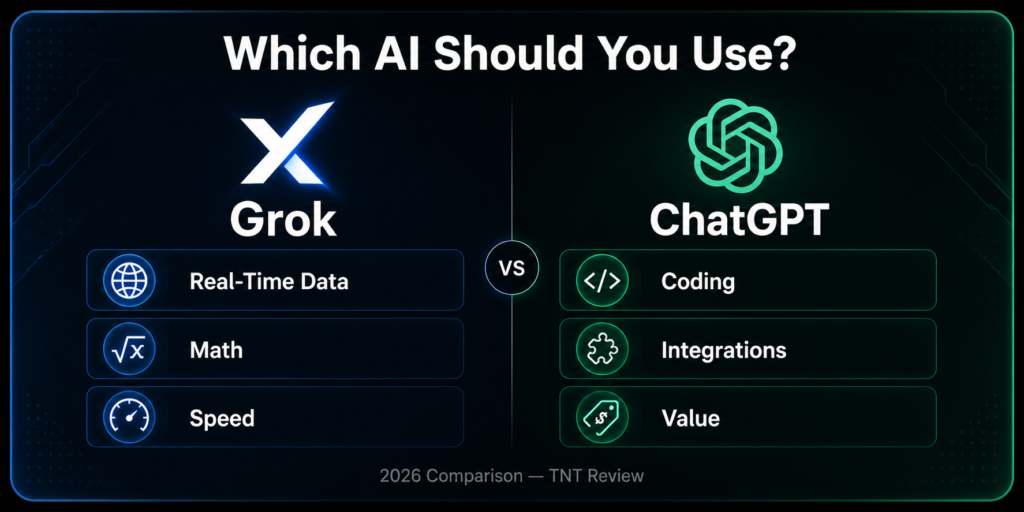
For most people, ChatGPT remains the better default in 2026. It wins on coding reliability, general accuracy, ecosystem maturity, enterprise features, and consumer pricing. If you’re paying for one AI assistant, ChatGPT Plus at $20/month covers more ground than SuperGrok at $30.
Grok is not a worse tool. It’s a different tool. Its real-time X integration, mathematical reasoning, speed advantage, and creative personality make it genuinely superior for specific workflows. For social media professionals and researchers especially, it’s worth the premium.
The smartest move for power users: run both at $50/month combined and route each task to the right model. That’s a combination that would have cost hundreds of dollars per hour in human labor just a few years ago.
For the official details on each platform, see ChatGPT at chatgpt.com and Grok at x.ai/grok.
Also worth reading: our full breakdown of ChatGPT Free vs Plus 2026 if you’re deciding which ChatGPT tier makes sense before you compare it to Grok, and Best Free AI Tools 2026 if you’d rather start without paying for either.